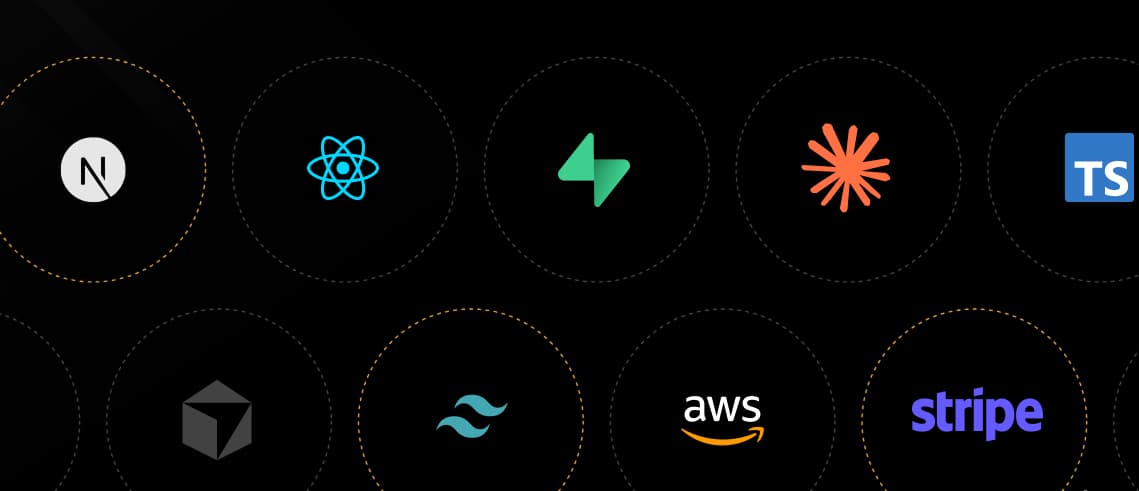
⚡️ Frontend
Next.js is my go-to for anything web. The App Router, server components, and built-in image/font optimization mean I don't have to make many decisions upfront — the defaults are good. I start every project with TypeScript.
Mobile — Expo
Expo makes React Native feel like React on the web. The managed workflow, over-the-air updates, and EAS Build handle everything I used to waste time on. One codebase, iOS and Android.
State Management — Zustand
Zustand is the right level of abstraction for most apps. No boilerplate, no providers, just a store you can read and write from anywhere.
🎨 Styles & Design
The new CSS-first configuration in v4 is a big improvement. No more tailwind.config.js for most projects — just a single CSS file. It's the most AI-friendly styling approach I've used.
shadcn/ui gives me accessible, well-designed components I actually own. tweakcn makes customizing the theme fast. Together they cover 90% of the UI work on any project.
Still the best tool for design handoff and high-fidelity mockups. I use it to prototype before I build, which saves time on the component side.
A great source of ready-made animated components. Useful when I want a specific interaction without spending hours on it.
🤖 AI
The fastest way to get a working UI from a description. I use it to scaffold components, then bring them into the codebase and adapt them.
The cleanest way to stream AI responses in a Next.js app. The useChat and streamText primitives make integrating LLMs feel like first-class Next.js features.
My preferred agentic coding tool for larger refactors, debugging, and multi-file changes. The model quality is noticeably ahead for complex reasoning tasks.
Models — Anthropic Claude Opus 4.6 + Sonnet 4.6
I use both depending on the phase of work. Opus 4.6 is my go-to for planning — architecture decisions, tricky TypeScript, and reasoning through complex problems. Once the direction is clear, I switch to Sonnet 4.6 for implementation. It's faster, cheaper, and more than capable for executing well-defined tasks.
📚 Knowledge & Planning
Notes — Notion
I keep everything in Notion: project notes, research, meeting summaries, and personal planning. The AI features are useful for quick drafts.
Documentation — Mintlify
Beautiful docs with minimal setup. Writing MDX, adding a mint.json, and deploying is all it takes. The AI-powered search is a nice bonus for users.
Project Management — Linear
Linear is the fastest issue tracker I've used. Keyboard-driven, opinionated, and it doesn't get in the way. I use it for everything from solo side projects to team work.
💻 Backend
Database — Supabase
Supabase gives me a Postgres database, realtime subscriptions, storage, and edge functions under one roof. The auto-generated TypeScript types from the schema save a lot of repetitive work, and the local development setup is solid.
Hosting — Vercel
Zero-config deployments for Next.js apps. Preview deployments on every PR, edge functions, and first-class integration with the rest of the stack.
🛠️ Tools
Editor — Cursor
Cursor is the editor I didn't know I needed. The agent mode, inline edits, and codebase-aware completions make it significantly faster than anything I used before.
Testing — Stagehand
Browser automation powered by AI. Stagehand lets me write tests in plain language and handles the brittleness that makes traditional E2E testing painful.
Auth — Clerk
Drop-in authentication with beautiful pre-built UI. Social login, MFA, and user management handled in a few lines of code.
Payments — Stripe
The standard for a reason. Stripe's API is well-documented, the test environment is reliable, and it covers every billing use case I've run into.
Analytics — PostHog + Vercel Analytics
PostHog for product analytics and feature flag insights. Vercel Analytics for Core Web Vitals and traffic — it's privacy-friendly and zero-config on Vercel.
Feature Flags — Vercel Flags
Shipping behind flags reduces risk on every release. Vercel Flags integrates with the rest of the Vercel stack and works seamlessly with the Edge Network.
Email — Resend + React Email
Writing email templates with React components is a game changer. React Email gives me real previews in the browser, and Resend's deliverability is excellent.